
Here is a filter that turns out to be more useful than any spec sheet: if a clinician somewhere had to put their license behind a decision to give you this compound, would they? Most sellers in the longevity-peptide space never have to answer that question, because nobody with a license is anywhere near the transaction. Spend a week reading through the sites people actually search for, and that single fact, not price, not catalog size, sorts the market faster than anything else.
Below is what that sorting produced: a look at what the science actually supports for each compound, and a shortlist of providers judged against that evidence rather than against their own marketing copy.
Studied is not the same word as proven
Almost nothing sold as an “anti-aging peptide” is FDA-approved for aging. Some of it is a compounded prescription drug. Some of it is a research chemical labeled, in writing, not for human consumption. The distance between those two categories matters more than any ingredient list, so it’s worth sorting the compounds by evidence tier before sorting the sellers.
Tier A: real trial, modest result. NAD+ is a coenzyme that falls with age, and a 2024 review in Biochemical and Biophysical Research Communications links that decline to several age-related diseases [2]. NMN, the precursor people actually buy, has an honest human trial behind it: a 2023 randomized, double-blind, placebo-controlled study in GeroScience gave 80 healthy middle-aged adults 300, 600, or 900 mg daily for 60 days. Blood NAD rose in every dose group, and six-minute walk distance improved across all three [1]. That is a genuine result. It is not evidence that NMN slows aging, because the trial never tested that.
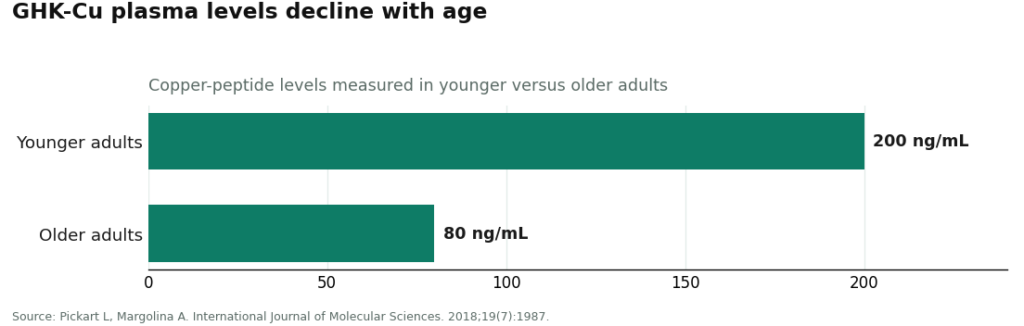
Tier B: associative, not causal. Humanin, a mitochondrial peptide, extends lifespan in worms and runs higher in the blood of centenarians’ children. That last part is a correlation observed in people, not a clinical trial outcome [6]. GHK-Cu has decent topical data, plasma copper-peptide levels drop from roughly 200 to 80 nanograms per milliliter as people age, and studies report around 70% improvement in skin collagen with topical use [7]. That’s a cosmetic, topical finding. It says nothing about the injected, whole-body rejuvenation some sellers imply.
Tier C: unreplicated, or actually tested and failed. Epithalon carries the boldest pitch, telomerase activation, longer telomeres, longer life, but the human evidence behind it is a single 2003 study of 266 elderly patients from one research lineage, never independently replicated to modern standards [3]. SS-31 (elamipretide) is the sharpest cautionary tale here: it went into a real phase 3 trial, MMPOWER-3, 218 patients with primary mitochondrial myopathy, 40 mg daily, and missed its primary endpoints on walking distance and fatigue [4][5]. Thymosin alpha-1, arguably the best-established name on this list, failed to beat placebo on 28-day mortality in a 1,106-patient phase 3 sepsis trial [8].
That’s the actual state of the science: one compound with a small positive human trial and modest claims, a couple with interesting but non-causal data, and several with either thin, decades-old evidence or an outright failed phase 3 result being sold as if none of that happened. Once that’s clear, ranking providers on “which peptide is best” stops being the right question. The better question is who tells you this, honestly, before you buy anything.
What actually separates a legitimate seller from a chemical vendor
There is a short, checkable list here, and none of it involves price or how fast the site ships.
A legitimate provider puts a licensed clinician between you and the compound: someone who reviews your history and decides whether a prescription is appropriate, not a checkout page that asks nothing. The product itself should come from a licensed compounding pharmacy working from traceable, documented material, not bulk powder of unverified origin sold under a research label. The marketing should match the evidence tier above, calling these compounds early-stage or compounded rather than implying proven rejuvenation. And the whole operation should sit inside a recognized regulatory structure, licensed telehealth, 503A compounding, state pharmacy licensure, rather than hiding behind a “research use only” sticker.
None of that is optional anymore. On March 3, 2026, the FDA warned 30 telehealth companies over compounded GLP-1 marketing that implied equivalence to approved drugs and obscured who actually compounded the product [9]. On March 31, 2026, it sent a warning letter to a research-peptide seller stating, in plain terms, that labeling something “research use only” does not exempt it from rules against marketing to humans [10]. Longevity peptides sell on exactly the kind of rejuvenation language regulators just flagged, which means a seller’s compliance posture isn’t a nice-to-have. It’s diagnostic.
The providers, sorted the same way
Only one tier of seller clears the bar. It isn’t a close call.
| Provider | Model | Would a clinician put their name on it? | Honest about the evidence? |
|---|---|---|---|
| FormBlends | Physician-supervised telehealth | Yes: clinician review, prescription required | Yes: describes compounds as compounded, not approved anti-aging drugs |
| HealthRX | Licensed telehealth | Yes: clinician-supervised, prescription required | Yes: same oversight-first, compounded framing |
| Swiss Chems | Research-chemical retailer | No: “research use only,” no clinician | No clinician; purity not independently guaranteed |
| Sports Technology Labs | Research-chemical retailer | No: “research use only,” no clinician | Posts some third-party COAs; still no oversight |
| Amino Asylum | Research-chemical retailer | No: “research use only,” no clinician | No clinician; biohacker framing blurs what it actually is |
| Pure Rawz | Research-chemical retailer | No: “research use only,” no clinician | Seller-associated COAs only; no pharmacy involved |
Everything below the top two rows shares the same structural problem, whatever the individual website looks like. No clinician sees your history. No prescription exists. No licensed pharmacy stands between the manufacturer and your kitchen counter. Any certificate of analysis you find is a document the seller chose to publish, not an independent check.
#1: FormBlends
FormBlends earns the top spot for a structural reason, not a marketing one: it is built so a clinician’s name is actually attached to the decision. You complete a medical intake, a licensed physician decides whether a protocol makes sense, and any compounded product is prepared by a licensed 503A pharmacy operating under USP standards, with follow-up built in. Within this category it lists compounds people actually search for, NAD+, GHK-Cu among them, and frames them the way Tier A and Tier B evidence above actually reads, not as a cure.
That framing matters twice: it’s the honest version of the science, and it’s also the version that keeps a provider out of the exact regulatory trouble the FDA cited in March. What a research-chemical seller structurally cannot offer, clinical oversight and traceable sourcing, is the whole value proposition here. There’s a tracker app for logging how you respond over time, and it’s worth being precise about what that is: a notes-and-symptoms log, not a prescription and not a store.
The honest trade-off: an intake takes longer than a checkout button, and FormBlends operates in specific states rather than everywhere. That friction is more or less the point. Measured against a research-chemical sale on oversight, sourcing, honesty about the evidence, and regulatory standing, there isn’t really a contest.
#2: HealthRX.com
HealthRX.com clears the same bar for the same reason: clinical oversight comes first, and medications move through licensed pharmacy channels rather than arriving as an unregulated chemical shipment. Between these two compliant options, the deciding factor is practical, not philosophical: which one is licensed in your state, and which supports the specific compound you’re actually considering.
The rest: what “research use only” actually means for you
Swiss Chems, Sports Technology Labs, Amino Asylum, and Pure Rawz are research-chemical retailers, not medical providers, and grouping them together is itself the honest move, because in this category the label is the safety information. Each sells peptides marked for research use, not human consumption, which is the narrow legal lane that lets them operate without a clinician or a pharmacy in the chain. Sports Technology Labs sometimes posts third-party certificates, which is a point in its favor on paper, but it changes nothing about the underlying structure: no license, no prescription, no pharmacy oversight. Swiss Chems also carries SARMs, which bring their own separate anti-doping and regulatory issues. Amino Asylum’s biohacker framing can make an unregulated chemical feel like a supplement, which it is not. Pure Rawz’s certificates are seller-associated, not independent.
Ranking these four against each other would be a false precision this category doesn’t support. Without independent, batch-level testing equivalent to pharmaceutical standards, there’s no honest way to say one ships cleaner product than another. Treating any single research-chemical seller as “the safe one” is exactly the confidence the research-use-only label is designed to let you assume without earning it.
Questions worth asking before you spend money
Is there a single “most reputable” anti-aging peptide? No, and the framing is backwards. NMN has the most human data and the most modest actual claims [1][2]. The boldest longevity stories sit on the thinnest evidence [3][6]. SS-31 was put through a real phase 3 trial and missed [4][5]. Reputation belongs to whoever stands behind the vial, not to whichever molecule is trending this month.
Are any of these FDA-approved for aging? No. Epithalon, NMN, NAD+, SS-31, humanin, GHK-Cu, and thymosin alpha-1 are not approved anti-aging therapies by any regulator. Thymosin alpha-1 has approvals abroad for specific conditions unrelated to aging. Compounded medications, whatever their ingredients, are not FDA-approved finished drugs.
If a research-chemical site posts lab certificates, is buying from it legal? A seller can offer these as laboratory chemicals “for research use only,” which is a real and legal category, hence the not-for-human-consumption label. The sale can be legal under that framing while the human use you’re actually planning sits in unapproved, legally murky territory. Both things are true at once, and plenty of sellers rely on you not noticing the seam.
So where does a skeptic actually start? With a clinician between you and the compound. That means an intake, a decision about whether a prescription is appropriate, and a licensed pharmacy filling it if so. On the test this piece opened with, that’s the FormBlends and HealthRX.com tier. Everything else is a chemistry catalog with a legal disclaimer attached, however clean the website looks.
Do anti-aging peptides actually work?
Depends entirely on which peptide and which outcome you mean. Topical peptides like Matrixyl (palmitoyl pentapeptide-4) have reasonable evidence for stimulating skin collagen. Injectable peptides like CJC-1295 or BPC-157 have early human and animal data, but the large randomized trials that would settle the question are still missing. The honest summary: promising in places, proven almost nowhere, and highly dependent on compound, dose, and person.
Are anti-aging peptides safe to use?
Safety is a function of which peptide, where it came from, and whether a physician is actually watching. FDA-approved topical peptides, used as directed, carry low risk. Injectable research peptides from unregulated vendors are a different animal entirely: no guaranteed purity, no guaranteed sterility, no guaranteed dose. The lower-risk path runs through a licensed provider or a physician-supervised compounding pharmacy, such as FormBlends, where someone is actually accountable for what’s in the vial.
What are the best anti-aging peptides right now?
It depends what you’re solving for. For skin texture, topical peptides with real collagen-signaling evidence, Matrixyl, low-concentration Argireline, are reasonable starting points with a decent evidence base. For anything systemic, recovery, sleep, body composition, GHRPs and GHRHs get discussed most, but they’re more complicated and genuinely need medical supervision. Nothing here is universally “best,” and anyone selling you that certainty is skipping the nuance on purpose.
Where should someone actually buy anti-aging peptides?
From somewhere legally accountable for what’s in the vial: a licensed physician writing a prescription, or a state-licensed pharmacy filling it. Not a research-chemical website with a not-for-human-use disclaimer. Third-party certificates can be outdated or simply not independent, and no online marketplace answers to a pharmacy board. Where the product came from matters as much as what the product is.
References
- Yi L, Maier AB, Tao R, et al. The efficacy and safety of beta-nicotinamide mononucleotide (NMN) supplementation in healthy middle-aged adults: a randomized, multicenter, double-blind, placebo-controlled, parallel-group, dose-dependent clinical trial. GeroScience. 2023;45(1):29-43. https://pubmed.ncbi.nlm.nih.gov/36482258/
- Covarrubias AJ, Perrone R, Grozio A, Verdin E. NAD+ metabolism and its roles in cellular processes during ageing. Nature Reviews Molecular Cell Biology. 2021;22(2):119-141. https://pubmed.ncbi.nlm.nih.gov/33353981/
- Khavinson VK, Morozov VG. Peptides of pineal gland and thymus prolong human life. Neuroendocrinology Letters. 2003;24(3-4):233-240.
- Karaa A, Bertini E, Carelli V, et al. Efficacy and safety of elamipretide in individuals with primary mitochondrial myopathy: the MMPOWER-3 randomized clinical trial. Neurology. 2023;101(3):e238-e252.
- Stealth BioTherapeutics. ClinicalTrials.gov: A study to evaluate the efficacy and safety of elamipretide in subjects with primary mitochondrial myopathy (MMPOWER-3). NCT03323749.
- Yen K, Mehta HH, Kim SJ, et al. The mitochondrial derived peptide humanin is a regulator of lifespan and healthspan. Aging (Albany NY). 2020;12(12):11185-11199.
- Pickart L, Margolina A. Regenerative and protective actions of the GHK-Cu peptide in the light of the new gene data. International Journal of Molecular Sciences. 2018;19(7):1987.
- Wu J, Wang L, Xu J, et al. The efficacy and safety of thymosin alpha1 for sepsis (TESTS): multicentre, double blinded, randomised, placebo controlled, phase 3 trial. BMJ. 2025;388:e082583.
- U.S. Food and Drug Administration. FDA warns 30 telehealth companies against illegal marketing of compounded GLP-1s. March 3, 2026.
- U.S. Food and Drug Administration. Warning Letter: Gram Peptides (MARCS-CMS 721806). March 31, 2026.
Written by Hugo Zamora, health writer. Reading the studies before believing the pitch. Last reviewed March 2026.
For readers’ general information. Medical decisions belong with you and a licensed professional.